
PTE Question Types 2026: All 22 Tasks Explained (Complete Hub)
Kooroo product and practice guidance reviewed on 30 October 2026. We may make mistakes; check Pearson's current task guidance and the question's feedback availability. Kooroo scores are practice estimates, not official Pearson results or predictions of an examiner's decision.
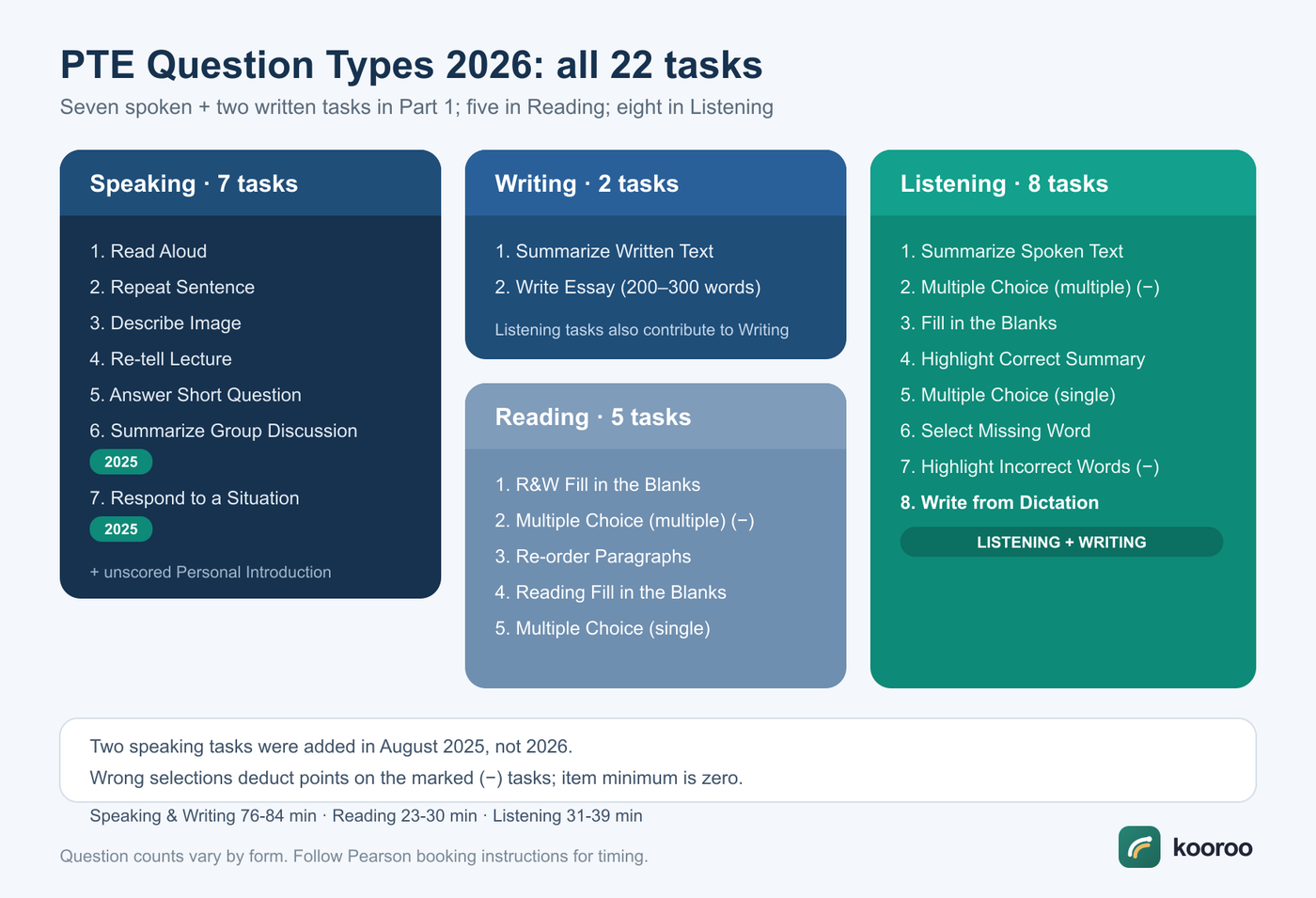
PTE Academic has 22 task types: nine in Speaking & Writing, five in Reading and eight in Listening. Summarize Group Discussion and Respond to a Situation were added on 7 August 2025. This guide explains the tasks and the skills they assess, with a practice sequence you can adapt to your own mistakes.
Question counts and timings vary slightly between test forms. Confirm specifics on the official Pearson test format page before test day.
How many question types are in PTE Academic 2026?
PTE Academic has 22 task types across three parts. Two speaking tasks were added on 7 August 2025. Pearson describes the test as two hours, while its published section timing ranges add to a longer total; follow the booking instructions for your appointment. Our exam-pattern guide explains the source discrepancy.
- Part 1: Speaking & Writing, 9 scored task types plus an unscored introduction, 76-84 minutes.
- Part 2: Reading, 5 task types, 23-30 minutes.
- Part 3: Listening, 8 task types, 31-39 minutes.
- Total: 22 task types across three parts. Pearson describes a two-hour test; the section ranges are not a fixed appointment duration.
Some tasks contribute to two communicative skills, while others contribute to one. Check Pearson's task-specific scoring table rather than inferring the scored skills from whether you read, listen, speak or type. Choose practice priorities from your recurring mistakes and required skill scores.
What are the PTE Speaking question types?
The Speaking module has 7 question types, all completed into a headset microphone in Part 1. It opens with an unscored Personal Introduction, a warm-up that institutions can hear but that never affects your score. Then the scored tasks begin:
- Read Aloud: read a paragraph of up to ~60 words aloud. Scores Speaking only, despite the reading input.
- Repeat Sentence: hear a sentence once, repeat it exactly. Scores Listening + Speaking.
- Describe Image: describe a chart, graph, or map after ~25 seconds of prep, speaking for ~40 seconds. Scores Speaking only. See our Describe Image without a template guide, then practise it live.
- Re-tell Lecture: hear a short lecture, then re-tell it in your own words. Scores Listening + Speaking.
- Answer Short Question: answer a general-knowledge question in one or a few words. Scores Listening only, despite being spoken.
- Summarize Group Discussion (added August 2025): listen to three people, then summarise their discussion in your own words. You have 10 seconds to prepare and two minutes to speak. The task contributes to Listening and Speaking. Practise Summarize Group Discussion with a free Kooroo account and check the feedback available for the question.
- Respond to a Situation (added August 2025): read and hear a scenario, then give an appropriate spoken response. The task contributes to Speaking; the listened input does not make it a Listening-scored task.
The two new tasks changed how Speaking should be prepared. They present unpredictable content, so a memorised template that used to carry Describe Image will not carry a group discussion you have never heard. Fluency built on real spontaneous practice is now the only reliable strategy, and our do PTE templates still work in 2026 guide shows exactly which tasks penalise a script the hardest.
What are the PTE Writing question types?
The Writing module has just 2 question types, both typed at the end of Part 1, but your Writing score is built from far more than these two tasks. Summarize Spoken Text and Write from Dictation, both in the Listening section, feed Writing too, which is why candidates who only practise essays often stall. Reading & Writing: Fill in the Blanks does not, despite its name; per Pearson's Score Guide it scores Reading only.
The two dedicated tasks are:
- Summarize Written Text: read a passage and write one complete sentence of 5-75 words within 10 minutes. Summarise the main idea and essential supporting information. A sentence is a grammatical unit; counting full stops alone is not a reliable way to judge whether it is complete.
- Write Essay: write 200-300 words within 20 minutes. The current rubric has seven traits. Since the August 2025 update, human experts additionally review Content; Development, Structure and Coherence; and General Linguistic Range. Develop an argument that addresses the actual prompt.
What are the PTE Reading question types?
Part 2 has five Reading task types within a published range of 23-30 minutes. They assess comprehension, vocabulary and relationships between ideas. There is no separate grammar section.
- Reading & Writing: Fill in the Blanks: choose words from dropdowns to complete a text. Scores Reading only; the name refers to the skills the task exercises, not the score it feeds.
- Multiple Choice, Choose Multiple Answers: several correct options; wrong picks lose a point each.
- Re-order Paragraphs: drag jumbled text boxes into the correct logical order.
- Reading: Fill in the Blanks: drag words from a bank into gaps in a text.
- Multiple Choice, Choose Single Answer: one correct option, no penalty for guessing.
Practise the task types where your answers repeatedly go wrong, and manage the shared section time. Multiple-answer questions deduct a point for each wrong selection, with a minimum item score of zero. Task counts alone do not establish a reliable marks-per-minute strategy.
What are the PTE Listening question types?
Part 3 has eight Listening task types and comes last. Some tasks also contribute to Writing or Reading. Practise maintaining attention through the section and review your own error patterns rather than assuming that its final task is always the most valuable one to drill.
- Summarize Spoken Text: hear a lecture, write a 50-70 word summary. Scores Listening + Writing.
- Multiple Choice, Choose Multiple Answers: wrong picks cost a point each.
- Fill in the Blanks: type the missing words in a transcript while you listen.
- Highlight Correct Summary: pick the paragraph that matches the audio. Also feeds Reading.
- Multiple Choice, Choose Single Answer: one correct option.
- Select Missing Word: the audio ends with a beep; choose what completes it.
- Highlight Incorrect Words: click the transcript words that differ from the audio; wrong clicks cost a point.
- Write from Dictation: hear a sentence and type the words you heard. It contributes to Listening and Writing. Use your own error pattern to decide how much practice it needs; this guide does not establish a universal highest-value task.
Which PTE question types matter most for your score?
Eight task types contribute to two communicative skills in the current Score Guide. The list below explains those pairings; it does not establish that every such task deserves more practice time than a task scoring one skill. Read Aloud contributes to Speaking only.
- Write from Dictation: Listening + Writing. Credit depends on reproducing the words with correct spelling.
- Summarize Spoken Text: Listening + Writing. Write a 50-70 word summary of the main point and supporting information.
- Repeat Sentence: Listening + Speaking. Repeat the words in the correct sequence with clear pronunciation and fluency.
- Re-tell Lecture: Listening + Speaking · Longer version of the same listen-then-speak mechanic
- Summarize Group Discussion: Listening + Speaking. Added in August 2025; summarise the speakers' contributions and their relationships.
- Summarize Written Text: Reading + Writing. Select the main idea and supporting points in one complete sentence of 5-75 words.
- Highlight Correct Summary: Listening + Reading. Select the summary that best represents the recording.
- Highlight Incorrect Words: Listening + Reading · Wrong clicks cost a point, so precision matters more than speed
A skill can receive contributions from tasks outside the section with its name. Check your own errors across those tasks before selecting a drill. A low Writing score, for example, does not by itself prove that dictation is a better priority than essay writing.
How should you practise the 22 question types? (a priority plan)
Use this sequence as an adaptable coverage plan. Start with a sample across all task types, record mistakes and spend extra time on repeated problems. Adjust the balance as your evidence changes; the sequence does not promise a particular score increase.
Work through this sequence:
- Week 1-2: the core four. Daily Write from Dictation and Repeat Sentence; alternate Summarize Written Text and Highlight Incorrect Words. Record yourself speaking and compare against the transcript.
- Week 2-3: the tasks added in August 2025. Practise Summarize Group Discussion and Respond to a Situation with responses built from each prompt.
- Week 3-4: the point-losers. Learn the negative-marking rules for both Multiple Choice (multiple) tasks and Highlight Incorrect Words: never select an option you cannot justify.
- Week 4: review the remaining task types and consider a timed mock. Follow that mock's published conditions, then leave time to analyse the report. Use Pearson's booking instructions for the actual test appointment.
- Ongoing: track your per-skill scores and re-weight practice toward whichever skill is lowest.
Practise PTE Academic question types on Kooroo. A free Kooroo account lets you attempt questions and sit mocks. Free questions include marking and applicable AI feedback; free mocks include reports. A one-time VIP pass unlocks marking and feedback on premium questions and reports for premium mocks. Kooroo scores are practice estimates, not official Pearson results or predictions of an examiner's decision.
Frequently asked questions
How many question types are in PTE Academic 2026?
PTE Academic has 22 scored task types: nine in Speaking & Writing, five in Reading and eight in Listening, plus an unscored Personal Introduction. The number of individual questions varies between test forms; that does not make the number of task types approximate.
What are the new PTE question types in 2026?
Summarize Group Discussion and Respond to a Situation were added on 7 August 2025, not in 2026. Both remain in the current Speaking & Writing section. The first asks you to summarise a three-person discussion; the second asks for an appropriate response to a scenario.
Which PTE question types are most important?
Choose practice priorities from your own errors and required scores. Eight tasks integrate two scored skills: Repeat Sentence, Retell Lecture, Summarize Group Discussion, Summarize Written Text, Summarize Spoken Text, Highlight Correct Summary, Highlight Incorrect Words and Write from Dictation. Their skill pairings do not prove a universal ranking of score impact.
Is the Personal Introduction scored in PTE?
No. The Personal Introduction at the start of the Speaking & Writing part is unscored: it exists to warm up your voice and check your microphone, and it is sent to institutions with your score report. Treat it as a practice run, not something to memorise a speech for.
Which PTE question types have negative marking?
Multiple Choice with multiple answers, in Reading and Listening, and Highlight Incorrect Words deduct a point for each incorrect selection. The item score cannot fall below zero. Other tasks use their own correct/incorrect or partial-credit rules; writing and speaking tasks also have task-specific form and content conditions.
Are PTE Core question types the same as PTE Academic?
No. PTE Core is a separate test for Canadian immigration with its own task mix built around everyday (not academic) English, though several formats overlap, such as Write from Dictation and Repeat Sentence. If your goal is Canada PR, check the PTE Core task list separately before you start preparing.